Apply NowSchedule a visit

B.Sc. in Economics and Data Analytics

Build the strategies that shape economies. Learn to forecast, value, and invest with confidence in a world that rewards data-driven financial leadership
Duration
3-Year Degree /
4-Year (Hons.)
Eligibility Criteria
60% in Class XII
(Any Stream) or equivalent IB /
A-Levels with Maths
Next Intake
July 2026
Session begins from 15th July 2026
In a world driven by data and shaped by dynamic markets, the intersection of Economics and Data Analytics is where the future of decision-making lies. The B.Sc. (Hons.) in Economics & Data Analytics at ATLAS SkillTech University is a cutting-edge four-year undergraduate program designed to prepare future-ready economists, strategists, and data-driven leaders

This program blends the analytical depth of economics with the technical precision of data analytics—empowering students to interpret real-world complexities through economic theory, quantitative tools, and data-driven insights.

Students learn to decode human behaviour, market trends, and global developments through data visualization, econometrics, coding, and predictive modelling. Whether it’s understanding how economic policy affects business or how AI is transforming financial markets, this program ensures graduates are fluent in the language of both economics and technology.
#1
Financial Accounting & Analysis
#2
Corporate Finance & Valuation
#3
Data Science & Predictive Analytics
#4
FinTech, Blockchain & Digital Finance
#5
Risk Management & Financial Derivatives
#6
Banking & Financial Services
#7
Managerial Economics & Global Markets
#8
Financial Modeling with Excel & Python
#9
Mergers, Acquisitions & Private Equity
#10
Business Law & Financial Compliance
#1
Navigate financial markets, systems, and instruments with ease
#2
Analyze business performance and make data-driven decisions
#3
Build forecasting models and valuation frameworks
#4
Evaluate risk and manage portfolios for optimized returns.
#5
Use tools like Excel and Python to solve
real-world financial challenges
#6
Lead financial strategies with precision, clarity, and insight
Finance & Banking: Financial Analyst, Risk Analyst, Quantitative Researcher
Consulting & Strategy: Business Consultant, Policy Analyst, Economic Advisor
Data & Technology: Data Scientist, Machine Learning Analyst, Product Analyst
Public Policy & Development: Economist, Research Associate, Impact Evaluation Specialist
Corporate & Market Research: Business Intelligence Analyst, Consumer Insights Manager

Semester 1

The first year builds a strong academic foundation that connects economic reasoning with analytical and digital fluency. Students are introduced to principles of microeconomics and macroeconomics, mathematical methods, and business statistics, while simultaneously developing competence in programming for analytics and data visualization. Courses in communication, critical thinking, and academic writing foster clarity of thought and expression—ensuring that every student learns to think like an economist and reason like a data analyst. This year nurtures intellectual curiosity and interdisciplinary awareness, setting the stage for deeper analytical exploration.
Microeconomic Analysis and Market Behaviour | Credits 4
This subject focuses on how individual consumers and firms make decisions, and how prices, demand, supply, and competition work in different markets.
Probability and Statistics I | Credits 4
This subject introduces basic probability concepts and statistical methods used to analyze data, measure uncertainty, and make informed decisions.
Foundations of Data Analytics | Credits 3
This subject introduces the basic concepts, tools, and techniques used to collect, clean, analyze, and interpret data for decision-making.
Basics of Excel | Credits 3
This subject covers the fundamental features of MS Excel, including data entry, formulas, formatting, and basic data analysis using spreadsheets.
Fundamentals of Business Communication | Credits 3
This subject teaches the basic principles of effective communication in a business environment, including professional speaking, writing, and interpersonal skills.
Atlas Elective | Credits 2
Allows students to explore interest-based subjects aligned with emerging fields and career pathways. Encourages applied, skill-focused learning.
Indian Behavioural Psychology | Credits 2
Introduces key behavioral concepts rooted in Indian psychological thought. Highlights decision-making, motivation, and cultural influences on human behavior.

Semester 2

The first year builds a strong academic foundation that connects economic reasoning with analytical and digital fluency. Students are introduced to principles of microeconomics and macroeconomics, mathematical methods, and business statistics, while simultaneously developing competence in programming for analytics and data visualization. Courses in communication, critical thinking, and academic writing foster clarity of thought and expression—ensuring that every student learns to think like an economist and reason like a data analyst. This year nurtures intellectual curiosity and interdisciplinary awareness, setting the stage for deeper analytical exploration.
Macroeconomic Analysis and Policy Frameworks | Credits 4
This subject studies the overall performance of an economy, including inflation, unemployment, and economic growth, along with government policies used to manage them.
Probability and Statistics II | Credits 4
This subject builds on advanced probability and statistical techniques, focusing on hypothesis testing, distributions, regression, and data-driven decision-making.
Mathematics for Economics I | Credits 4
This subject covers the basic mathematical tools such as algebra, functions, and graphs that are essential for understanding and solving economic problems.
Interactive Data Visualisation | Credits 3
This subject focuses on creating dynamic and interactive charts and dashboards to present data clearly and help users explore insights effectively.
Research Design | Credits 3
This subject teaches how to systematically plan a research study, choose appropriate methods, and structure data collection to answer research questions effectively.
ATLAS Elective | Credits 3
Provides flexibility for students to pursue an elective aligned with their interests or engage in an applied social-impact project that builds real-world experience.
Orientation of Indian Constitution
Introduces key constitutional principles, governance structures, and civic responsibilities, building awareness of India’s legal and policy foundations.

Semester 3

In the second year, students move from foundational understanding to applied problem- solving. They engage with intermediate microeconomics and macroeconomics, econometric modeling, and public policy analysis, learning to use data to test economic hypotheses and interpret real-world patterns. Parallelly, they acquire technical expertise through database management, Python and R programming, and quantitative data analysis, linking economic theory to real-time applications. Behavioral economics, policy case studies, and skill-enhancement courses strengthen their ability to draw actionable insights from complex datasets and dynamic market environments.
Financial Markets & Banking | Credits 4
Learn the basics of planning, organizing, and leading. Build strong foundations for effective business management.
Industrial and Labour Economics | Credits 4
Explore cultural influences on design and visual communication. Understand how aesthetics shape perception in the Indian context.
Mathematics for Economics II | Credits 4
Discover AI-driven applications for modern business needs. Enhance efficiency, decision-making, and innovation with AI.
Python for Data Science and Economic Applications | Credits 3
Teaches structured model-building techniques using spreadsheets and analytical tools. Focuses on forecasting, scenario analysis, and financial decision modelling.
Program Elective | Credits 2
Provides foundational understanding of leadership, organizational behavior, and management approaches. Links classic management theories with contemporary business practices.
Live Project / Summer Internship / Live coaching for professional courses / Summer School | Credits 2
Allows students to pursue a specialization area aligned with their interests and career goals, supporting deeper skill development.
Life Skill & Human Values - Chanakya Neeti | Credits 2
Offers immersive work experience in a professional setting. Students apply classroom learning to real business tasks, gaining practical industry exposure.

Semester 4

In the second year, students move from foundational understanding to applied problem- solving. They engage with intermediate microeconomics and macroeconomics, econometric modeling, and public policy analysis, learning to use data to test economic hypotheses and interpret real-world patterns. Parallelly, they acquire technical expertise through database management, Python and R programming, and quantitative data analysis, linking economic theory to real-time applications. Behavioral economics, policy case studies, and skill-enhancement courses strengthen their ability to draw actionable insights from complex datasets and dynamic market environments.
Financial Modelling | Credits 3
This subject focuses on building mathematical and analytical models to evaluate financial performance, forecast future outcomes, and support business and investment decisions.
Econometrics I | Credits 3
SQL for Data Management and Analytics | Credits 2
This subject introduces statistical techniques used to analyze economic data and test economic theories using real-world data.
Machine Learning for Business and Policy Analytics | Credits 2
This subject teaches how machine learning techniques are used to analyze data, predict outcomes, and support decision-making in business and public policy.
Research Methodology for Economics | Credits 3
This subject focuses on the methods and techniques used to conduct economic research, including data collection, analysis, and interpretation of economic data.
Intellectual Heritage of Economic Thought | Credits 3
This subject explores the evolution of economic ideas and theories developed by major economists over time and how they shape modern economic thinking.
Program Elective | Credits 3
This subject allows students to choose a specialized course based on their interests, helping them gain deeper knowledge in a specific area of economics or data analytics.
Environment & Sustainability | Credits 3
This subject focuses on understanding environmental issues and promoting sustainable use of natural resources for long-term economic and social well-being.

Semester 5

The third year brings integration, where students apply economic thinking to business, finance, and public systems using modern analytical tools. They explore advanced econometrics, machine learning for economists, and financial analytics, connecting statistical models to market behavior and decision-making. Exposure to data-driven policy evaluation, global political economy, and impact assessment helps them understand how data informs governance, sustainability, and strategy. A summer internship or applied project bridges academia and industry, allowing students to implement classroom knowledge in live environments—building professional readiness and problem-solving acumen.
Public Economics & Finance | Credits 4
This subject examines how governments raise revenue, spend funds, and design policies to manage the economy, focusing on taxation, public expenditure, and financial management.
Economic Analysis & Public Policy | Credits 2
This subject focuses on using economic principles and data analysis to evaluate public policies and their impact on society and the economy.
Development Economics | Credits 3
This subject studies the economic development of countries, focusing on poverty, inequality, growth strategies, and the factors that improve living standards in developing nations.
Econometrics II (Time Series and Panel Data) | Credits 3
This subject focuses on advanced econometric techniques used to analyze time-based data and panel data to study economic trends and relationships over time.
AI Applications in Economic and Social Analysis | Credits 3
This subject explores how artificial intelligence is used to analyze economic and social data, predict trends, and support policy and decision-making.
Big Data Analytics and Cloud Platforms | Credits 3
This subject covers the tools and techniques used to process and analyze large-scale data using cloud-based platforms for efficient storage, computing, and insights generation.
Live Project / Summer Internship / Live coaching for professional courses / Summer School | Credits 2
This component provides hands-on practical experience through real-world projects, industry internships, professional training, or short-term academic programs to build practical skills and career readiness.

Semester 6

The third year brings integration, where students apply economic thinking to business, finance, and public systems using modern analytical tools. They explore advanced econometrics, machine learning for economists, and financial analytics, connecting statistical models to market behavior and decision-making. Exposure to data-driven policy evaluation, global political economy, and impact assessment helps them understand how data informs governance, sustainability, and strategy. A summer internship or applied project bridges academia and industry, allowing students to implement classroom knowledge in live environments—building professional readiness and problem-solving acumen.
International Economics | Credits 4
This subject studies trade between countries, exchange rates, balance of payments, and how global economic policies affect international markets and economies.
Environmental and Resource Economics | Credits 2
This subject studies how economic activities affect the environment and how natural resources are managed efficiently for sustainable development.
Behavioural Economics | Credits 3
This subject studies how psychological, social, and emotional factors influence economic decisions, beyond traditional rational decision-making models.
Game Theory and Strategic Behaviour | Credits 3
This subject studies how individuals and firms make decisions in competitive situations where the outcome depends on the actions of others.
Social Science Data Analytics | Credits 3
This subject focuses on using data analysis tools and techniques to study social issues, human behavior, and patterns in society for informed decision-making.
Predictive Modelling for Policy and Market Analysis | Credits 3
This subject focuses on using statistical and machine learning techniques to predict market trends and evaluate the impact of public policies on the economy.
Soft Skills for Finance Professionals II | Credits 3
This subject focuses on advanced communication, leadership, teamwork, and professional ethics required for success in the finance and business industry.

Semester 7

The final year is a culmination of specialization, research, and professional development. Students choose to pursue either an Honours research dissertation or an applied industry project, focusing on areas such as development economics, environmental policy, financial modeling, or AI and big data analytics. They learn advanced tools in data science, econometric forecasting, and policy consulting, synthesizing their technical and theoretical learning into impactful outcomes. This year transforms students into independent thinkers and professional analysts—equipped to lead in the evolving landscape of economics, technology, and data-driven decision-making.
International Finance | Credits 3
This subject examines how money flows across countries, focusing on exchange rates, global financial markets, foreign investments, and international monetary systems.
Gender & Society | Credits 3
This subject studies the roles, rights, and inequalities related to gender in society, focusing on social structure, identity, and empowerment.
Advanced Econometrics | Credits 4
This subject covers advanced statistical and quantitative methods used to analyze complex economic data and improve the accuracy of economic forecasting and policy analysis.
Applied Research Methodology | Credits 4
This subject focuses on practical research techniques used to design studies, collect real-world data, and analyze results for solving real-life problems.
Text and Web Analytics for Business Intelligence | Credits 4
This subject focuses on analyzing text data and web data using analytical tools to extract insights that support business decision-making and strategy.
Data Ethics, Privacy, and Governance | Credits 3
This subject focuses on the responsible use of data, including ethical issues, data privacy protection, and the rules and policies for managing data securely and fairly.

Semester 8

The final year is a culmination of specialization, research, and professional development. Students choose to pursue either an Honours research dissertation or an applied industry project, focusing on areas such as development economics, environmental policy, financial modeling, or AI and big data analytics. They learn advanced tools in data science, econometric forecasting, and policy consulting, synthesizing their technical and theoretical learning into impactful outcomes. This year transforms students into independent thinkers and professional analysts—equipped to lead in the evolving landscape of economics, technology, and data-driven decision-making.
Green Finance and Carbon Markets | Credits 3
This subject explores how financial tools are used to support environmentally sustainable projects, along with the functioning of carbon markets that help reduce global emissions.
Predictive Analytics for Global Economic Trends | Credits 3
This subject focuses on using data analytics and predictive techniques to forecast global economic patterns, growth, and future market movements.
Data-Driven Decision Making for Policy and Business | Credits 2
This subject focuses on using data analysis and evidence-based insights to make informed decisions in business strategies and public policy planning.
Dissertation / Capstone Project
This is a major independent project where students apply their knowledge and skills to solve a real-world problem through research, analysis, and practical implementation.

Why Choose B.Sc. (Hons.) in Economics and Data Analytics at ATLAS?

Understand Core Economic Principles

Grasp the fundamentals of micro and macroeconomics to interpret markets, policies, and global trends.
01

Think Critically About Economic Issues

Analyse real-world problems using economic theory and evidence-based reasoning.
02

Master Data Analytics Tools & Techniques

Apply statistical methods, programming, and visualisation tools to extract insights from complex datasets.
03

Integrate Economics with Data Science

Combine economic models with advanced analytics for informed decision-making and forecasting.
04

Apply Econometric & Predictive Models

Use regression, hypothesis testing, and machine learning to solve business and policy challenges.
05

Communicate Insights Effectively

Present data-driven findings and economic analyses in clear, impactful ways for diverse audiences.
06

Conduct Independent Research

Design and execute research projects addressing contemporary economic and social issues.
07

Innovate for a Digital Economy

Leverage big data and AI-driven tools to create solutions for emerging economic and business challenges.
08

Where concepts meet execution,
in and beyond the classroom.

The B.Sc. in Economics and Data Analytics course is designed to immerse you in the realities of finance from day one. Through real-world simulations, industry projects, and hands-on learning experiences, you’ll develop the skills that top employers value most.
Live Industry
Projects
In marketing strategy, market research, and financial analysis
Startup Street Collaborations
Run brand campaigns or develop finance models for real ventures
Client Campaign Execution
Across digital, retail, and
fintech sectors
Field Research, Consumer Surveys
Analyze markets, map consumer behaviour, and uncover insights
Internships & Global Immersions
With agencies, corporates, and investment firms
Industry Projects & Showcases
Where you pitch to professionals and potential investors
Live Case
Studies
Drawn from top brands, startups, and financial institutions
Strategy & Financial Simulations
Replicating real-time business environments
Sprints & Investment Challenges
That test your creative and analytical thinking.
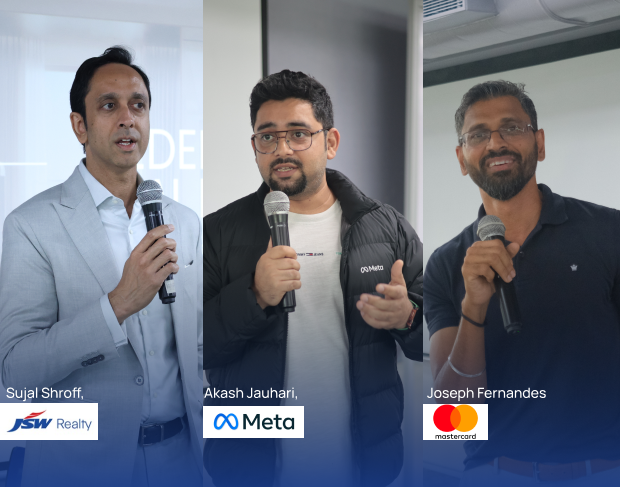
CXO-Led Masterclasses
From experts in marketing, finance, consulting, and beyond
Marketing &
Finance Labs
With live data, dashboards, and campaign tools
Design Jams &
Crisis Simulations
For high-pressure decision-making

Student Voices: Real Voices from the Program

Hear from our students
At ATLAS, we’re not just learning from books, we get to work on real challenges that actually make a difference.
Eshan Thackur
3rd Year
BBA Student
It feels like running our own little company sometimes.That hands-on experience is what makes being here so exciting.
Mahafrin Deboo
3rd Year
BBA student
I love the professors here and their enthusiasm, its not what they teach but what they bring to the class.
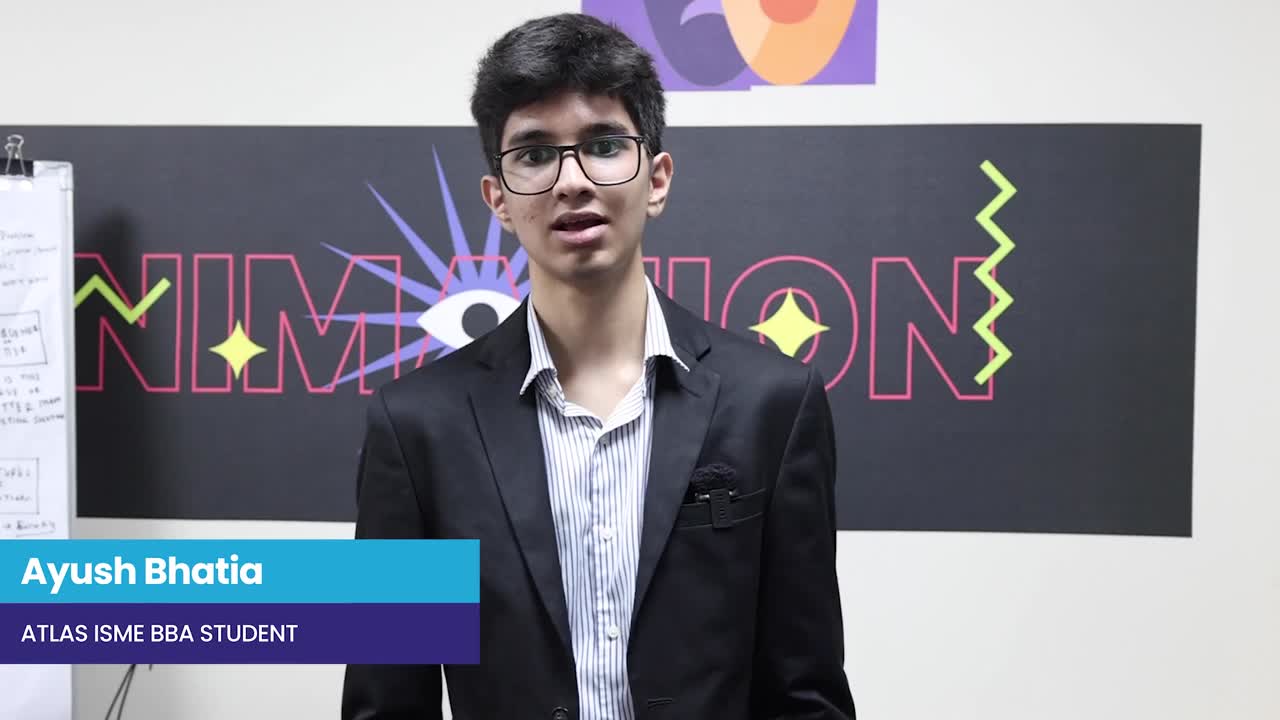
Ayush Bhatia
Class of 2023
BBA student
I always thought I knew Entrepreneurship, my perspective completely changed, thanks to my professors at ATLAS ISME
Diya Chanda
Class of 2023
BBA student
Eligibility
Indian Boards (ISC / CBSE / State Boards)
  • Minimum 60% overall in Class XII
  • Mathematics is a mandatory subject
A-Levels (UK)
  • Minimum grades A, B, or C in any 2 subjects
  • Plus a Grade B or above in Mathematics
  • Total of 3 subjects required
International Baccalaureate (IB)
A minimum of 24 points, including:
  • 3 Higher Level (HL) subjects
  • 3 Standard Level (SL) subjects
  • Mathematics is mandatory

Ready to Build a Business Degree
That’s Built for the Real World?

Craft a future-ready degree with your
choice of Majors & Minors
More questions?
Let our AI Assistant answer your queries

Questions? We can read your mind

ISDI provides B. Des to its students in various subjects. The undergraduate B. Des programme is a four-year course that enables students to enhance their focus on strategic thinking, design, and innovation. 

The undergraduate B. Des program offers 7 programs in various design subjects, such as:

  • Communication Design

  • Fashion Design

  • Fashion Communication & Styling

  • Interior Design

  • Product Design

  • Strategic Design Management

  • Animation & VFX

The postgraduate programme focuses on entrepreneurial and design thinking skills.

ISDI is a well-known institution for many reasons. Its exclusive collaboration with Parsons School of Design stems from its position as a renowned institution. The key factors setting ISDI apart are:
  • Location: It is in the heart of Mumbai and surrounded by the best design organisations.

  • Industry-focused approach: With industry stalwarts and meteors guiding students, individuals not only learn from practical knowledge but also learn from experience.

  • Networking: Students can work and interact with professionals in other fields, strengthening their networking skills. 

  • Global curriculum: The curriculum has been meticulously designed to prepare students for national and international work opportunities.

Experiential learning: ISDI believes in going beyond traditional learning, and utilises advanced technology to nurture creativity among students.

Yes, ISDI offers guest lectures and masterclasses as a part of the curriculum. International voices and mentors lead classes with its exclusive partnership with Parsons School of Design (Parsons faculty often visits ISDI and students learn from them here in India). Integrating a masterclass allows students to expand their cultural understanding, too. We introduce students to a variety of workshops and masterclasses that help expand their interests and solidify their vision.

ISDI hosted  Parsons Week 2025, in partnership with ISDI,  from March 23-28, 2025, featuring a week of design-focused events and sessions led by faculty from the renowned Parsons School of Design. During their visit to ISDI, they offered masterclasses and portfolio review sessions as well.
Yes. ISDI offers global opportunities, too. Students get opportunity to study overseas, during immersive excursion one such example is Paris where students visited colleges such as

  • Students can study in Paris and participate in industry visits and workshops. 

  • Partnership with Parsons School of Design ensures that thinking strategies, global tools, and methodologies are a part of the curriculum.

ISDI stands out from other design schools through its partnership with Parsons School of Design. Its urban-rich culture setting ensures students learn thoroughly. ISDI stands out from other design schools due to its unique features:

  • A rich curriculum benefits from its collaboration with Parsons School of Design.
  • Real-world internships and masterclasses

  • Diverse networking

  • Strategic thinking nurtured by industry experts

Yes, the curriculum is developed in collaboration with Parsons School of Design. The B Des curriculum is meticulously designed to allow students to benefit from it. The global curriculum expands their horizon of understanding and ensures they are able to face challenges and secure lucrative opportunities.

The ISDI - School of Design & Innovation has received curriculum development support from Parsons School of Design since its establishment in 2013.

This unique partnership for curricular excellence ensures ISDI students have access to a global contemporaneity curriculum and proven teaching and learning methods enabling our students to be the design leaders of the future.

ISDI has designed its curriculum in collaboration with Parsons School of Design. The curriculum ensures academic excellence and alignment with industry by:

  • Design professionals design curriculum.

  • Professionals hold masterclasses for students to learn from experience.

  • Students are encouraged to take up projects which challenge them to face real-life design challenges.

  • Working on projects with industry-leading companies

  • Regular workshops held by industry professionals

ISDI integrates industry into its curriculum in several ways. We aim to blend classroom learning with real-world experience. The industry learnings are integrated through:

  • Masterclasses with experts

  • Industry-led collaborations and projects

  • Hackathon for understanding real-life disciplines

  • Visits to different design studios for better learning

Yes, ATLAS ISDI organises live projects with brands as part of its curriculum. The thoughtfully curated curriculum is in collaboration with Parsons School of Design. The curriculum includes internships with top brands. This internship nurtures

  • Applying theoretical knowledge to real-life problems

  • Strengthen problem-solving skills

  • Build a strong portfolio

  • Learn from the experience of senior citizens.

  • Guided by industry experts

ISDI has always aimed to create a safe and immersive campus as well as a learning experience for its students. With a thoughtful curriculum in collaboration with the renowned Parsons School of Design, every design module for specialisation is distinct and focuses on strengthening the design principles. The student experience at ATLAS ISDI includes:

  • Students get to participate in various competitions, which channel their design creativity.

  • Students are made to participate in various workshops.

  • Students have to work on several projects and increase their networking and communication skills.

  • Students participate in various college festivals and experience personal growth through faculty-led discussions and talks

ISDI has an exclusive campus. Renowned for its infrastructure and thoroughly curated curriculum, the institution allows students to widen their area of learning. With our recent NAAC A Grade certification, our campus provides its students with:

  • The campus features large laboratories, designer studios, fashion technology zones, and various other spaces where students can explore and showcase their creativity.

  • Immersive workshops for strengthening design principles, along with frequent visits to design studios, inspire the students.

  • Students can learn from experts through frequent immersive workshops held in design studios.

  • Design Studios

  • Fashion Lab

  • Product Lab (Workshop)

  • Fashion Studio

  • Digital + UX Labs

  • Maker Spaces

ISDI offers its students a variety of events for them to participate in and cherish their campus life. From flagship events to cultural events, ATLAS ISDI is always thriving throughout the year. Extracurricular activities offered by ATLAS ISDI are:

  • Design Events

  • Startup-Streets

  • Industry Masterclasses, Workshops, RTCs

  • Master’s Admissions Events

  • Placement & Career Events

  • Fests & Cultural Showcase

  • Hackathons & Challenges

  • Podcasts & Fireside Chats etc.

These interactions boost engagement by allowing students to display projects, share ideas, and connect with visitors.

Yes, ISDI requires an entrance exam for design programmes. The admission process has been designed to gauge the design skills and communication skills of the students. The ISDI admission entrance exam consists of:

  • Portfolio upload or design project holding a 40% weightage

  • The online aptitude test holds a substantial weightage of 40%.

  • Along with tests, there is a round of private interviews as well, which test the students' reasoning and analytical skills.

The process to apply for ISDI’s B.Des program is extremely simple. ISDI focuses on inclusivity, and our admissions process has been designed for individuals to seek their desired design specialisation. The admission process follows these steps:

  • Submitting the portfolio

  • Those students who do not have a portfolio can also complete a design project listed by ATLAS ISDI.

  • Along with submitting a portfolio and/or design project, there is an aptitude test which gauges the student’s communication skills.

  • The last test is the private interview test. This test allows our panel to understand the ambitions and goals of the students.

ISDI is among the renowned institutions for the B. Des Program. The eligibility criteria for ISDI are:

Students currently studying in Grade 12 and appearing for their 10+2 board exams are eligible to apply. This includes boards like:

  1. CBSE

  2. ICSE

  3. HSC (Maharashtra)

  4. IGCSE A-Levels

  5. The IB Diploma Program (IBDP) 

  6. Any recognised national or international equivalent.

At ISDI, there is no stream restriction; students from Arts, Commerce, or Science backgrounds are welcome. What matters most is your interest in design, creativity, and innovation. So if you are a science student with a profound interest in design and art, you can give wings to your dreams here at ISDI.

Yes, students are required to submit their design portfolio. Students can:

  • Upload their portfolio while working on their IDSI Challenge

  • The portfolio should contain eight to ten pieces of your best work that proficiently display your design skills. 

  • These pieces can be animated, painted, or sketched according to the student's preference.

Those students who do not have a portfolio can simply:

  • Complete the ISDI Design Project

  • Create a visual work inspired by any ONE of the given themes: One World | Tracing Nature | Translating Tomorrow

  • All forms of design are acceptable, including drawing, video, photography, sculpture, 3D work, collage, and digital images. 

  • Support your project by writing a 500-word essay describing how you developed your ideas.

A. Yes, students who are not in a design program can also apply to study ISDI. We have always believed in inclusivity, and our dynamic selection process ensures that students from diverse backgrounds, including those without a design background, can apply.

Career opportunities after graduating from ISDI are innumerable. Graduates can work as:

  • Art Director

  • Brand Manager

  • Digital Transformation Analyst

  • E?commerce Brand Strategist

  • Design Consultant

  • UX Research Analyst

  • Strategy Consultant

  • Fashion Designer

ISDI has always believed in supporting students beyond their campus as well. Our committee works diligently to help students secure their desired jobs. ISDI assists students in building a strong portfolio by providing:

  • Hands-on experience working in a state-of-the-art lab with cutting-edge design tools.

  • A curriculum that emphasises experiential learning and interdisciplinary approaches will introduce projects that enable students to learn and overcome the challenges they regularly face in their field of study.

  • Our guidance and placement committee provides comprehensive support to help students secure the right internship and lucrative opportunities.

A. ISDI helps the students in building a portfolio and guiding them through job placements as well. We help students by:

  • Having projects which enhance their portfolio

  • Guest lectures and masterclasses

  • SOPs

  • Projects which are a compulsory part of modules

  • Documentation of the project as a part of the portfolio

ISDI always ensures a promising future for its students. Our committee oversees every student's secure internships with top organisations that match their specialisations and career goals. 

  • Interns can work with renowned companies.

  • Work for esteemed designers

  • Gain hands-on experience with live projects and internships

  • Committees are made to make job hunting easy.

ISDI has an astounding record for placements. ATLAS ISDI has a placement committee which works dedicatedly for every student to ensure their placements. The committee guides the students to reach out to a job where their expertise can shine. The curriculum allows students to gain skills, which are:

  • Work for alumni organisations.

  • Work on certifications, which strengthen their credibility.

  • They should maintain an attractive portfolio that aids in securing better placements.

Yes, ATLAS ISDI supports entrepreneurship. The thoughtfully curated module, in collaboration with Parsons School of Design, is designed for students to learn about the principles as well as the dynamics of business. The curriculum is mostly aimed at:

  • The curriculum aims to integrate management with technology and emerging design principles in order to enhance students' skills.

  • Students are encouraged to join the evolving design ecosystem and become innovative designers or entrepreneurs.

  • The global immersion curriculum helps students understand the complexities of the business field, which arise in the design landscape.

Yes, ISDI graduates who have completed their design programme can effortlessly open their own ventures. This can be easily achieved because:

  • ISDI curates a curriculum that includes modules on entrepreneurial leadership. The modules encourage a business mindset with innovation and design in the lead. 

  • The learning environment at ISDI is nurtured by a mentorship ecosystem where industry stalwarts lead masterclasses for students.

  • Students gain comprehensive knowledge about innovation, entrepreneurship, and practical challenges.

  • Graduates graduate with a mindset that combines design and entrepreneurship skills, which are crucial for their venture.